





China's New Rule Further Regulates its Outbound Investment
2026-06-292118
打开微信,扫一扫二维码
订阅我们的微信公众号
打开手机,扫一扫二维码
即可通过手机访问网站并分享给朋友
China Daily reported that data from the Ministry of Commerce showed that China's outbound direct investment reached US$ 174.38 billion in 2025, up 7.1% from a year earlier and remaining among the world's top ranks. When China's outbound investment is continuing to grow, Chinese companies are expanding their presence in sectors ranging from manufacturing to green energy and digital technologies. Along with such growth, challenges from protectionism, geopolitics tension, governance, and the like are increasing significantly.
The State Council, China's cabinet, recently unveiled a new rule, the Rule on Outbound Investment (the “Rule”) which will take effect on July 1, 2026. It is China's latest efforts to regulate outbound investment, with an aim to bolster high-level opening-up, expand investment cooperation and better safeguard national security.
1. The Rule gives a broad definition of outbound investment, covering not only corporate investment but resident individuals' overseas investment
The outbound investment refers to those activities whereby enterprises, organizations and resident individuals within the territory of China (collectively the “Investors”), by way of contributing assets or equity, or providing financing, guarantees, and the like, directly or indirectly obtain ownership, control operational management rights and other related rights and entitlements in respect of enterprises, assets, and the like in other countries (regions).
The Rule will also regulate (a) the Investors' investments in foreign financial markets by using their own funds, funds raised and other entrusted funds; and (b) their re-investments in foreign countries or regions by using assets, rights and entitlements received from outbound investments.
It is expected that there will be specific regulation on resident individuals' outbound investment. It will mean that resident individuals' direct overseas investment, which is currently subject to strict restrictions and available only through limited legal vehicles, may see a gradual opening up under the framework as set by the Rule. It deserves our continued attention how the new regulation and the new supervision mechanism will impact on the individuals' investment through SPV, Chinese employees' participation in incentive plans of foreign public companies and other individuals' overseas investment in grey areas.
2. Transfer of critical assets, technologies, services and data through outbound investment is prohibited
Meta & Manus deal is a typical example. Xiao Hong, a famous Chinese entrepreneur, founded “Butterfly Effect” (currently known as Manus) in Wuhan and Beijing, China. Manus launched in invitation-only beta, dubbed a “general AI agent”. Butterfly Effect then relocated its headquarters from Wuhan and Beijing to Singapore, expanded its international operations while winding down the operation in China. On December 29, 2025, Meta announced the acquisition of Manus. Meta did not disclose financial terms, but the deal was reportedly valued between US $2-3 billion. However, Manus' core AI algorithms, recommendation tech, and key data were developed in China and classified as restricted export items under China's Catalogue of Technologies Prohibited or Restricted from Export. Any transfer, licensing, or overseas sale of such controlled tech requires prior approval from Chinese authorities. In addition, under the Foreign Investment Security Review Measures (FISR), foreign acquisitions of Chinese-related entities in sensitive sectors (e.g., core AI) that may affect national security are subject to mandatory review. Meta and Manus had not gone through all such mandatory procedures before its deal closing. In April 2026, China's FISR office banned the Meta & Manus deal.
Now the Rule explicitly prohibits any transfer of critical assets, technologies, services and data through outbound investment. Specifically, the Investor shall not:
(1) export or use goods, technologies, services, and related data whose export is prohibited;
(2) export or use, without permission, goods, technologies, services, and related data whose export is restricted;
(3) transfer to other countries (regions) goods, technologies, services, and related data whose export is prohibited, by means such as cross-border dispatch of technical personnel, organizing personnel to work in other countries (regions), cross-border provision of technical guidance, or arranging cross-border training of personnel; or
(4) transfer to other countries (regions), without permission, goods, technologies, services, and related data whose export is restricted.
Accordingly, where an outbound investment involves the cross-border transfer or offshore use of technology, services or related data originating from China, the analysis generally needs to cover two Chinese regulatory regimes: technology import and export administration and export control.
China's technology import and export administration is governed by the Foreign Trade Law and related regulations, with the primary aim of protecting domestic technological competitiveness. Compliance largely depends on the Catalogue of Technologies Prohibited or Restricted from Export, which classifies technologies into three categories: prohibited, restricted, and freely exportable.
In addition, China's export control regime is primarily aimed at safeguarding national security and national interests, preventing proliferation, and fulfilling its international obligations. The regime establishes a unified regulatory framework for dual-use, military, and nuclear technologies (commonly call “military and dual-use technologies”) and also introduces certain extraterritorial enforcement measures. Exporters shall refer to the effective Chinese export control lists, including the Arms Export Administration List and the Catalogue of Dual-Use Items and Technologies Subject to the Administration of Export Licenses. Exporters may rely on detailed technical parameters, such as computing capability, encryption strength, precision, bandwidth, material composition, or processing performance listed in the above lists. Even if a technology is not expressly listed, a license may still be required if the exporter knows or should know the technology could affect national security or be used for military, weapons of mass destruction, or terrorism-related purposes.
3. The Rule sets up outbound investment security review for the first time
Under China's current ODI mechanism, national security is one of the factors that the relevant governmental authorities need to consider when examining and approving ODI applications. For example, applicants should address in application reports whether overseas investment projects have impact on national interest and national security.
Apparently, the Rule will set up an independent security review mechanism. In general, China's National Development and Reform Commission (NDRC), Ministry of Commerce (MOFCOM) and other relevant ministries will conduct security review of outbound investment and transfer or disposal of relevant assets, rights and entitlements that affect or may affect national security interests. The Investors and related organizations or individuals are required to provide assistance and cooperation and shall comply with the security review decisions.
It is expected that detailed implementation regulation on security review will be issued in the near future.
4.Chinese government will classify industrial sectors into encouraged, restricted and prohibited sectors to guide outbound investment
NDRC issued the Catalogue of Sensitive Industries for Outbound Investment in 2018. The catalogue lists the industries that enterprises are restricted from making outbound investment, such as real estate, hotel, entertainment, sport club and equity investment funds or investment platforms abroad without specific industrial projects. Overall, the catalogue is rough. The Rule vows to formulate, adjust, and implement outbound investment classifications and specify outbound investment industries that are encouraged, restricted, or prohibited, regulating the Investors’ investment and business activities.
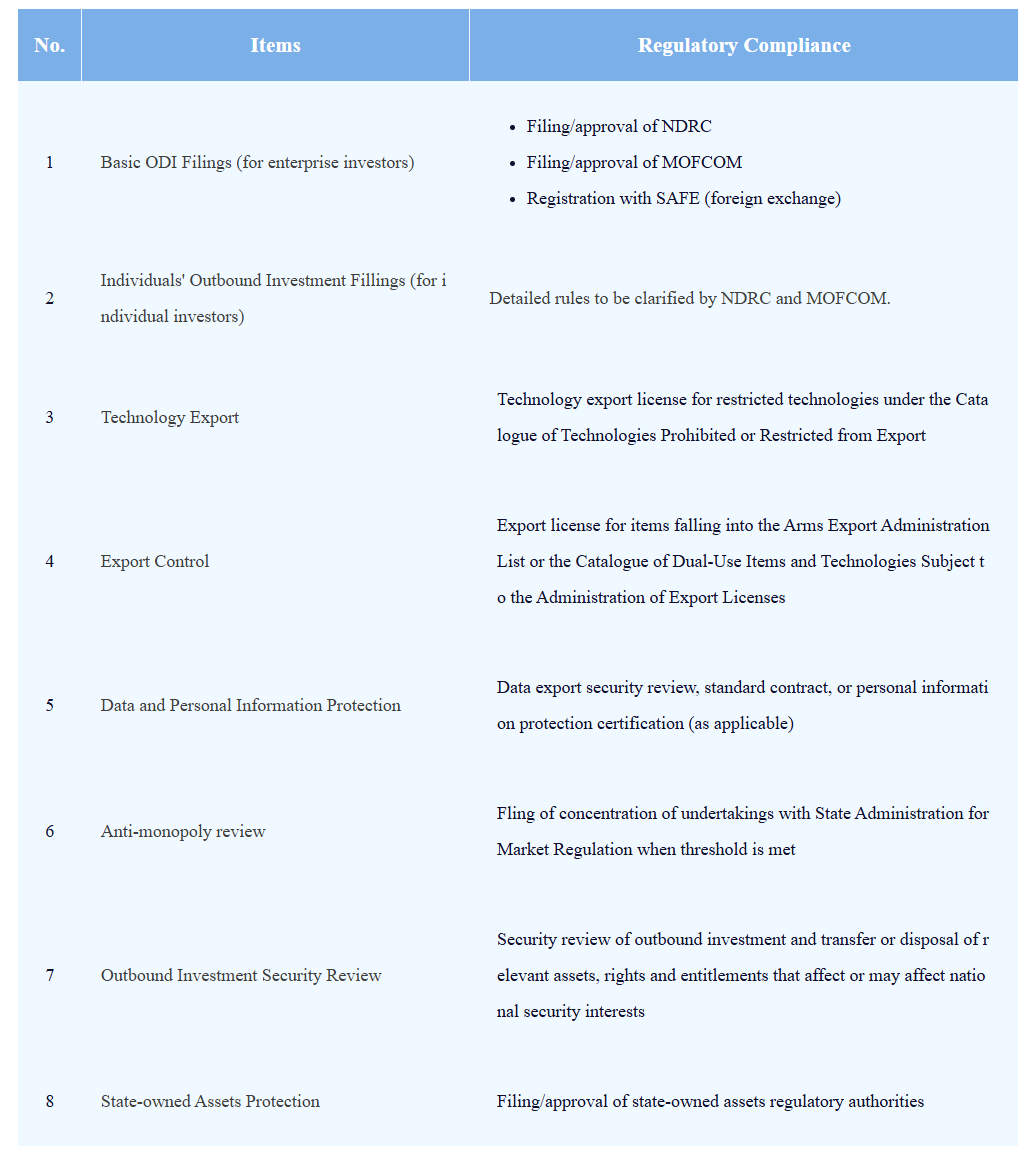
5.The Rule establishes a regulatory framework for outbound investment
In summary, the Investors should take into account the following regulatory compliance when planning outbound investment:
6.The Rule authorizes countermeasures against discriminatory restrictions, arbitrary business disruptions and other practices that undermine the interests of Chinese Investors abroad
If any country (region) or international organization adopts discriminatory prohibitions, restrictions, or other similar measures against China in respect of investment and business operations and the like, Chinese government may take corresponding measures to protect the safety and legitimate rights and entitlements of the Investors and their outbound investment.
If foreign organizations or individuals endanger China's national sovereignty, security, or development interests, violate normal market transaction principles by interrupting normal transactions with Chinese enterprises, other organizations, or individuals, or adopt discriminatory measures against the Investors and their outbound investment, or unreasonably deprive or restrict the legitimate rights and entitlements of the Investors and their outbound investment, Chinese government may take such measures as prohibiting or restricting them from engaging in import and export activities related to China, prohibiting or restricting them from investing within the territory of China, prohibiting or restricting organizations and individuals within the territory of China from conducting relevant transactions or cooperation with them, prohibiting or restricting the entry of relevant personnel, products, and means of transportation, and cancelling or restricting the qualifications of relevant personnel to work, stay, or reside within the territory of China.
7.MHP Observations and Key Takeaways
(1) For years resident individuals are not allowed to invest abroad with limited exceptions, such as QDII and employees participating in incentive plans of foreign listed companies. The Rule, for the first time, formally includes resident individuals into outbound investors, and requires NDRC and MOFCOM to formulate specific regulation on resident individuals’ outbound investment. Therefore, it is particularly noteworthy whether the specific regulation can open up a genuine compliant channel for individuals to make cross-border investments while effectively controlling risks.
(2) It is reasonable for us to anticipate that Chiense government will formulate and issue a comprehensive outbound investment catalogue covering encouraged, restricted and prohibited industrial sectors to replace or integrate the existing sensitive industry catalogue. Investments involving cutting-edge sectors such as semiconductors, artificial intelligence, quantum computing and advanced materials may likely be classified as restricted or prohibited sectors, triggering security reviews. We may need to pay close attention to the comprehensive outbound investment catalogue and assess its impact on ODI filing/approval and other related compliance requirements, especially the outbound investment security review.
(3) It appears that outbound investments will face scrutiny of regulatory compliance through their whole life cycle. More importantly, the compliance focus for outbound investment is also changing. The Investors now need to move beyond analyzing whether a single act technically triggers a particular regulatory rule. Instead, they should assess the transaction as a whole, including:
technology characteristics;
control arrangements;
data flows; and
broader national security implications.
Looking forward, Chinese government authorities are likely to place increasing emphasis on substantive effect rather than formal transaction structure.
(4) To avoid Meta & Manus deal type risks, for transactions involving industry-leading or strategically important technologies, the Investors should consider engaging with relevant regulators at an early stage to better understand:
regulatory expectations;
potential concerns; and
feasible transaction pathways.
Early-stage regulatory communication may help reduce the risk of:post-closing regulatory intervention;restrictive conditions; orforced unwinding of the transaction.
(5) Cross-border transaction documents (like share purchase agreement) need a health check, especially those clauses closely relating to regulatory compliance. For example, ODI approval/fling, one of the closing conditions, usually refers to basic ODI approval/filing of NDRC, MOFCOM and SAFE and now it should be updated to cover the whole outbound investment regulatory framework; R&W clauses should pay more attention to origins of critical assets, technologies, services and data involved and make clear whether they are subject to restrictions or prohibitions under China's outbound investment rules.